AI & Law
The Pulse of Legal AI Is Taken at Stanford. LLM x Law
The first time I had the opportunity to attend Stanford's LLM x Law Hackathon was in September 2023, the second edition… I heard about it through Alejandro Salinas de León.
 Aldo Ricardo Rodríguez CortésLegal AI · AI & Law
4 min read
Aldo Ricardo Rodríguez CortésLegal AI · AI & Law
4 min read
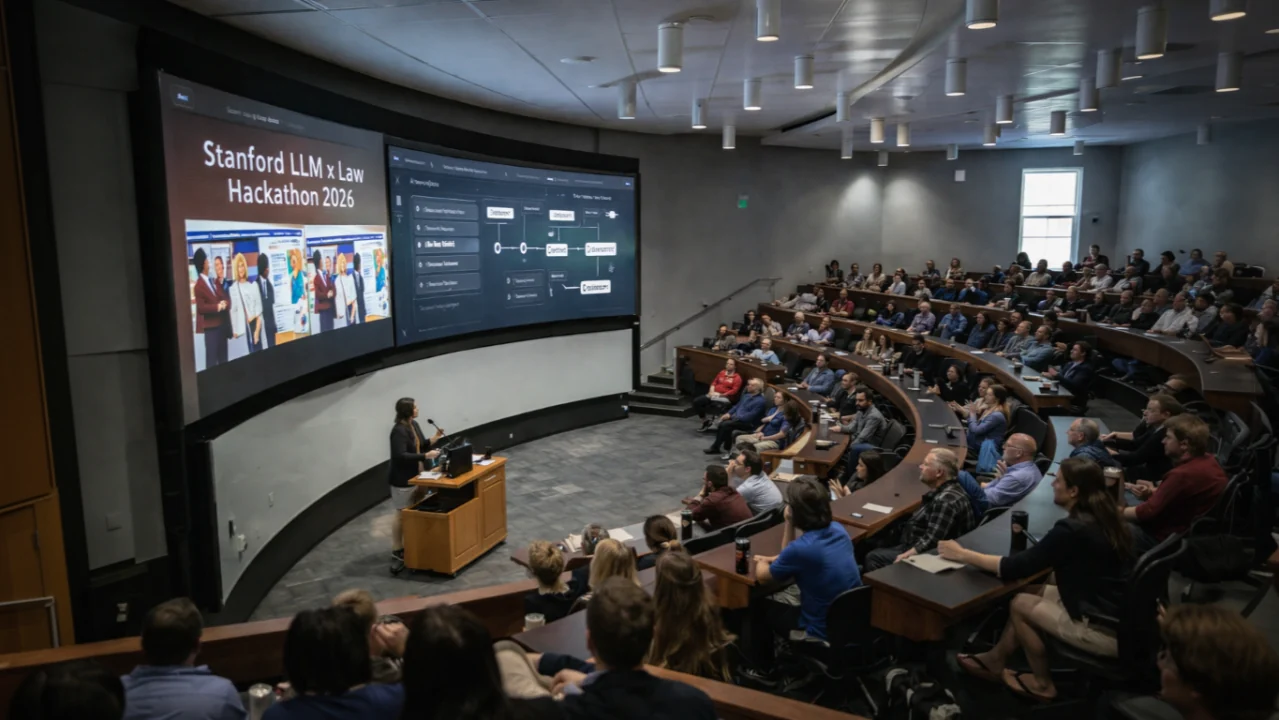
The first time I had the opportunity to attend Stanford's LLM x Law Hackathon was in September 2023, the second edition — I heard about it through Alejandro Salinas de León. Everyone built chatbots. Every single one. No exceptions. 150 people, eight hours to build whatever they could with artificial intelligence, and every team presented some variation of the same thing: a chatbot that knew about something. Labor law. Contracts. Immigration. Intellectual property. The competition wasn't about ideas — it was about prompts. Mine cites case law. Yours hallucinates laws that don't exist. Theirs sometimes works and sometimes freezes halfway through the pitch.
ChatGPT was less than ten months old. The context window was 16,000 tokens — about twelve pages (60 times less than what we have available today). If you wanted it to analyze a long contract, you had to cut it into pieces and pray. RAG was the novelty, and those who implemented it seemed like magicians. There was no multimodality. There were no agents. The model received text and returned text. Nothing more.
And we found it astonishing.
Today I was at the sixth edition of the same hackathon. More than 400 people, more than 70 teams. The entire Stanford Law School — classrooms, hallways, courtyards — taken over by people from near and far, including more than a few who traveled expressly from other states and other countries to be there. Students in their twenties working side by side with experts in their sixties. AI is so new that it erases hierarchies: everyone starts from zero, everyone is equal.
Today the pitches get cut off for lack of time — not because something broke. In 2023 the presenter used their hands to sketch what the screen should have been showing. In 2026 the problem is that three minutes aren't enough to show everything you built.
One person alone or a team of four. One laptop each. Eight hours.
I haven't missed a single edition since the second, and what I've seen change in that place tells a story that exists nowhere else.
This hackathon is organized by CODEX, the center that operates between Stanford Law School and the Department of Computer Science — more than twenty years exploring what happens when legal code meets software code. But the hackathon is something else. It is a convergence point that is not replicated anywhere in the world: at the heart of Silicon Valley, AI researchers share a table with startup founders, Bay Area developers team up with lawyers who have never written a line of code. The mechanics are simple: you show up, you code, and at 7 p.m. you have three minutes in front of judges and peers to demonstrate that your idea works. Live. You pray to the Demo God — the silent deity of live presentations — that nothing breaks at the exact moment it matters most and has you more nervous than you already are.
What makes this a perfect thermometer is that nobody has an incentive to lie. This isn't an OpenAI press release. It isn't a lab benchmark. It isn't a Wall Street analyst projecting the future. It is what a real person, with real tools, can build from nothing in a day. No more, no less.
Each edition has a dominant trend that reveals where the frontier lies. In 2023, chatbots. Then came agents — tools that didn't just respond but executed chained actions. Every six months, the previous trend was absorbed as a basic feature. What yesterday was the winning project, today was the starting point.
In April 2026, the trend is Obsidian-style knowledge graphs: networks of nodes and connections that visually represent how legal knowledge is interrelated. The pitches are no longer nervous demos where something can break at any moment — they are presentations of products that look finished. And the problem is no longer that something fails. The problem is that three minutes are not enough to convey the depth of what you built in eight hours. Teams build so many features, so completely, that the pitch slot becomes an exercise in brutal editing: what do I leave out?
And that is the observation that matters. Not that AI improved — we already know that. What matters is what that improvement enables in the hands of ordinary people. The distance between "I had an idea" and "I have a working product" collapsed from months to hours. What in 2023 would have been a master's thesis was built in 2026 on an afternoon. What yesterday required a team of engineers is today done by a lawyer who learned to code two months ago.
No industry report captures that. No benchmark measures it. But a hackathon does.
The next time you want to know what state artificial intelligence is truly in, look at what a small team can build in eight hours. And compare it to what they could build last year.
That delta is the true pulse of AI. And it is taken at Stanford.
Special congratulations to Pierre-Loic Doulcet for making it possible, and to the SLS and CodeX team.