IP & Copyright
The Potential Breakdown of Good Faith in Copyright Law in the Face of Works Made with Artificial Intelligence
Have you seen this INDAUTOR ruling? Seriously, have you? I can't believe it. This completely reverses the burden of proof…
 Aldo Ricardo Rodríguez CortésLegal AI · AI & Law
5 min read
Aldo Ricardo Rodríguez CortésLegal AI · AI & Law
5 min read
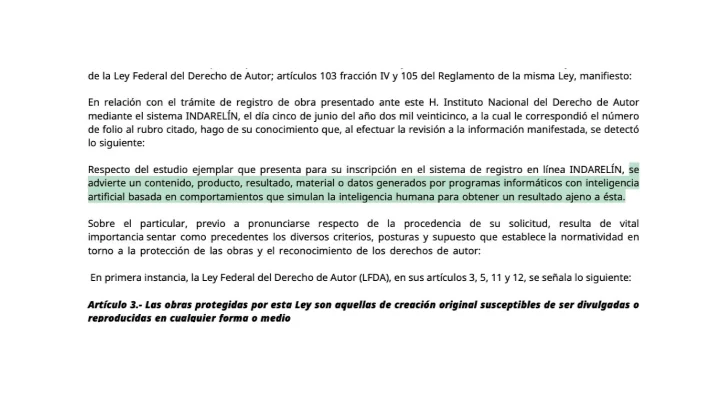
"Have you seen this INDAUTOR ruling? Seriously, have you? I can't believe it. This completely reverses the burden of proof. Isn't good faith supposed to be presumed?"
"Well, yes, but look... wow, this is a problem."
The ruling states verbatim: "With respect to the exemplary study submitted for registration in the online registration system INDARELÍN, content is detected that constitutes a product, result, material, or data generated by computer programs with artificial intelligence based on behaviors that simulate human intelligence in order to obtain a result external to it."
The Instituto Nacional del Derecho de Autor (INDAUTOR) has issued this ruling denying registration of a work based solely on that perception. With this decision, the administrative authority has broken a fundamental principle: the presumption of good faith that underpins the entire registration system.
The Denial Ruling
What is troubling is that there is no clear distinction regarding the degree of AI involvement in the creative process. Until recently, the conversation centered on whether the person's substantial participation was sufficient or insufficient to warrant the granting of rights — the well-known "BY" versus "WITH" the use of tools debate. Here, however, everything is entirely black or white: if AI is used, then the work falls within the prohibited category, regardless of the degree of use. While it is true that there is no express statement to that effect, the absence of any such clarity suggests this possible interpretation.
The Legal Framework and Its Limits
The Mexican copyright system rests on clear premises established in Articles 162 through 164 of the Federal Copyright Law (Ley Federal del Derecho de Autor — LFDA):
The purpose of registration is to ensure legal certainty and to give public notice of works. Literary works, artistic works, adaptations, and translations may be registered. The grounds for denial are specific: non-protectable works, public domain, duplicate registrations, and advertising campaigns.
- The purpose of registration is to ensure legal certainty and to give public notice of works
- Literary works, artistic works, adaptations, and translations may be registered
- The grounds for denial are specific: non-protectable works, public domain, duplicate registrations, and advertising campaigns
None of these grounds includes "suspicion of AI use." Nevertheless, INDAUTOR's interpretation is that the work lacks originality, on the theory that because it was made by an artificial intelligence over which the author had no creative control, it is devoid of that quality. The authority also states in multiple other rulings that copyright may only be granted to human persons, and that anything produced by a computer system falls outside the scope of protection.
The problem is that this interpretation does not distinguish between degrees of human participation in the creative process.
A Ruling That Fractures the Declarative System
This particular ruling runs counter to the declarative and good-faith principle that characterizes the registration process. Rather than the simple administrative procedure it should be, this decision lacks the basic qualities that are fundamental to copyright registration.
The system was designed to be swift and trust-based: the applicant submits the work, good faith is presumed, and the authority registers it unless an express ground for denial exists. In this specific case, however, INDAUTOR introduces elements that transform the procedure:
It claims to detect AI-generated content without explaining how. It shifts to the applicant the burden of proving a negative fact. It turns a simple administrative procedure into one where the citizen must justify that they did nothing wrong.
- It claims to detect AI-generated content without explaining how
- It shifts to the applicant the burden of proving a negative fact
- It turns a simple administrative procedure into one where the citizen must justify that they did nothing wrong
The Multiple Consequences
The reversal of the burden of proof produces devastating effects:
Total legal uncertainty. The applicant can no longer predict whether a work will be registrable. The decision depends on opaque, subjective criteria applied at the authority's discretion.
Perverse incentives. Those who honestly disclose having used AI tools are placed at a disadvantage compared to those who omit that information. Opacity is rewarded; transparency is penalized.
Violation of the rule of law. A government authority may act only within the powers expressly conferred upon it. By creating new grounds for denial, INDAUTOR becomes a de facto legislator.
Erosion of a fundamental right. Copyright protection, which arises automatically upon creation (Art. 5 LFDA), becomes contingent on arbitrary administrative criteria.
The Interpretation That Matters
I have read countless commentators who categorically assert that works made with AI as a tool are registrable. Here we have evidence that the authority is not applying that logic.
The international legal debate draws a clear distinction between works created BY AI (without human intervention) and works created WITH AI (where the human directs and selects). In most real-world cases, AI acts as an auxiliary tool while the human author conceives ideas, formulates specific instructions, selects results, and presents the final work.
INDAUTOR does not see it that way, and as a result acts on an interpretation different from those who argue that this distinction rescues works with human intervention. It places under suspicion anyone who uses AI, even where clear and sufficient human creative intervention exists.
I've Seen This Chapter Before
This reasoning mirrors what the U.S. Copyright Office (USCO) did with Zarya of the Dawn — a line of thinking that has been evolving since 2022 and today yields registrations such as A Single Piece of American Cheese (with certain reservations, of course).
International experience shows that the dilemma is not new. The USCO recognizes that AI-assisted works may be registered if there is sufficient human creative direction. The European Union insists that the key is substantial human intervention, not the tool employed.
The guiding principle should be technological neutrality: the law must not discriminate based on the tool used. A camera, Photoshop, or a language model are auxiliary means; authorship rests with the natural person who employs them creatively.
The Underlying Problem
Under this criterion, anything that currently enjoys copyright protection could be flagged for possible AI involvement in the creative process. Under this interpretation, the author's title and rights would be subject to proving that no AI intervention took place.
This means that under this burden-shifting logic, the following works could be left unprotected: any song that used an AI-powered synthesizer, any photograph taken with a smartphone that has intelligent adjustment features, any article that was edited with AI assistance, any design that employed automated tools. Everything that involved the use of AI tools would not be eligible for protection.
This is extremely dangerous given that AI is increasingly a tool used across all creative industries. The mere suspicion of AI use taints the entire work, regardless of the degree of human involvement. It is as if any modern digital tool were grounds for automatic disqualification.
Final Reflection
The real problem is not that AI cannot be an author — that question is legally settled: it cannot —. The problem is that by breaking the presumption of good faith, the Mexican copyright system abandons its declarative nature and becomes a procedure in which technological guilt is presumed.
The challenge is not to deny registrations on suspicion, but to recognize human creativity mediated by new tools. If we do not correct this course, we will penalize transparency, discourage innovation, and leave the works of the present in a state of legal limbo.