IP & Copyright
What Would the OpenAI Proposal for a National AI Action Plan Look Like on Copyright If It Had Been Proposed in Mexico.
This document published on March 13, 2025 — a set of proposals from OpenAI — aims to strengthen United States leadership in AI…
 Aldo Ricardo Rodríguez CortésLegal AI · AI & Law
4 min read
Aldo Ricardo Rodríguez CortésLegal AI · AI & Law
4 min read
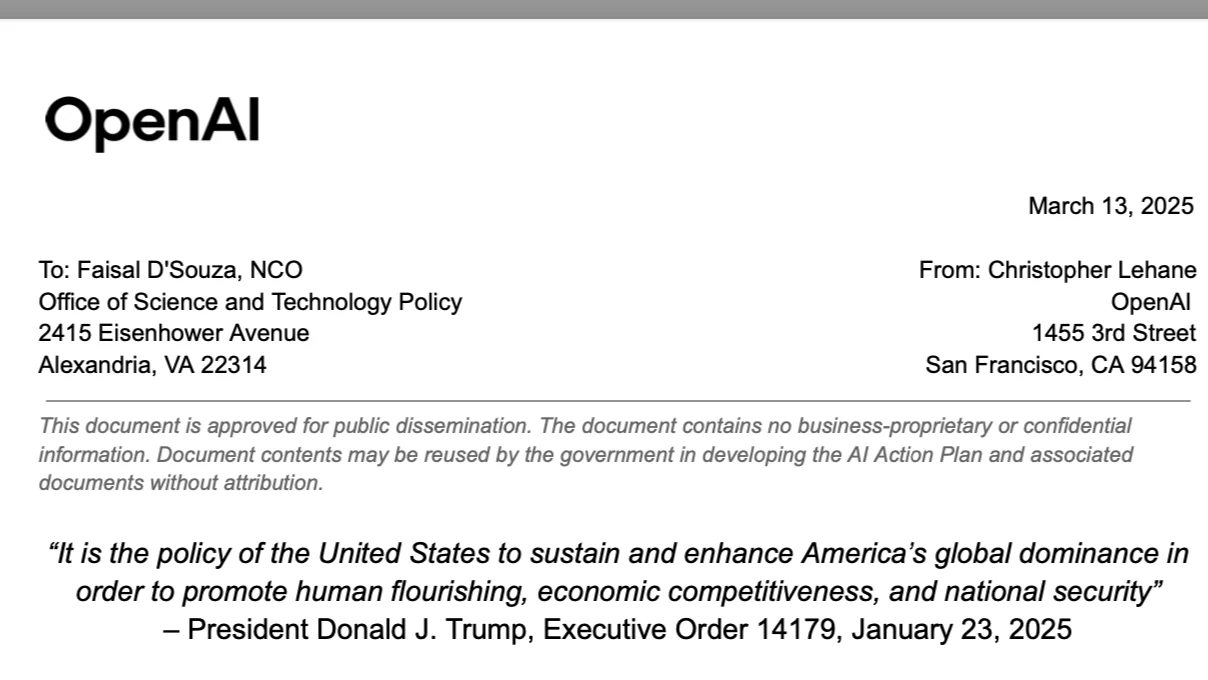
This document, published on March 13, 2025, containing OpenAI's proposals, aims to strengthen United States leadership in artificial intelligence (AI) in a context of growing global competition, particularly with China. It was signed by Chris Lehane, who holds the position of Vice President, Global Affairs at OpenAI.
At OpenAI, there is concern about the rise of AI developed by the Chinese Communist Party (CCP), which they perceive as autocratic and authoritarian, and the company seeks to ensure that U.S.-led AI, grounded in democratic principles, prevails.
The document is structured as follows:
1. Preemption: Ensuring the Freedom to Innovate
[Regulatory preemption: Guaranteeing the freedom to innovate]
2. Export Controls: Exporting Democratic AI
[Export controls: Spreading democratic AI]
3. Copyright: Promoting the Freedom to Learn
[Copyright: Promoting the freedom to learn]
4. Infrastructure: Seizing the Opportunity to Drive Growth
[Infrastructure: Seizing the opportunity to drive growth]
5. Government Adoption of AI: Leading by Example
[Government adoption of AI: Leading by example]
6. About OpenAI
[About OpenAI]
Personally, the section that interests me most is 3. Copyright: Promoting the Freedom to Learn.
3. Copyright: Promoting the Freedom to Learn
What does OpenAI propose on the subject of copyright?
OpenAI has submitted a series of proposals to the U.S. government, arguing that a balanced copyright strategy is essential for three key objectives: promoting the freedom to learn, securing American leadership in AI, and protecting the country's economic and national security.
The company emphasizes that the U.S. intellectual property system, with its well-established fair use doctrine, plays a fundamental role in protecting transformative uses of existing works. This doctrine allows innovators to experiment and build within a balanced and predictable framework. According to OpenAI, this approach has been the foundation of U.S. technological success in the past and becomes even more important in the era of artificial intelligence.
OpenAI's concrete proposals on copyright
Defending training as transformative use — arguing that the extraction of statistical patterns during model training constitutes a "fair use" that neither substitutes nor devalues the original work, and should therefore continue to be permitted without the need for individual licenses. Avoiding "opt-out" regimes that restrict training data — warning that European text-and-data-mining models with opt-out mechanisms hinder innovators and raise R&D costs; requesting that the United States not adopt similar schemes. Presenting the national security argument — underscoring that if China can train its systems on all types of works while the U.S. restricts access to protected data, American technological advantage will erode; preserving fair use thus becomes a critical matter of competitiveness and national security. Promoting pro-innovation government action — OpenAI specifically requests the Executive Branch and Congress to:
1. Defend training as transformative use — arguing that the extraction of statistical patterns during model training constitutes a "fair use" that neither substitutes nor devalues the original work, and should therefore continue to be permitted without the need for individual licenses. 2. Avoid "opt-out" regimes that restrict training data — warning that European text-and-data-mining models with opt-out mechanisms hinder innovators and raise R&D costs; requesting that the United States not adopt similar schemes. 3. Present the national security argument — underscoring that if China can train its systems on all types of works while the U.S. restricts access to protected data, American technological advantage will erode; preserving fair use thus becomes a critical matter of competitiveness and national security. 4. Promote pro-innovation government action — OpenAI specifically requests the Executive Branch and Congress to:
a. Actively engage in international forums to prevent less innovative countries from imposing restrictive rules on U.S. companies.
b. Monitor the effective availability of data for American developers and identify foreign barriers.
c. Facilitate access to and digitize public datasets (government-held or publicly funded) to expand the volume of data available for training.
d. Intervene in litigation or domestic debates when pro-innovation copyright principles are at risk.
Does the document address compensation or licensing payments?
No. OpenAI explicitly maintains that model training constitutes a transformative use that "does not replicate works for public consumption" nor "erodes their commercial value," and is therefore fully covered by the fair use doctrine and requires no additional compensation to the authors of original works.
All the measures it proposes to the government are aimed at preserving the application of this doctrine, broadening access to public data, and defending U.S. companies against regimes that introduce opt-out mechanisms — not at establishing compensation funds or collective licenses.
Page 10 of the Document
Page 11 of the Document
What would a similar document look like if presented in Mexico?
If this document were proposed in Mexico, it would take a different approach: rather than defending "fair use" (which does not exist in Mexican law), it would advocate for a modernization of the Federal Copyright Law to explicitly include AI training.
The argument about competition with China would be recast as a narrative around economic development and closing technological gaps, while incorporating considerations for the protection of Mexico's cultural heritage.
Fundamentally, whereas OpenAI seeks to preserve existing advantages, a Mexican version would articulate a path for developing new capabilities within an emerging technology ecosystem.
Without a doubt, 2025 is marking a turning point for those of us who are passionate about intellectual property law and technology. Personally, I support this proposal from OpenAI because it reflects a fundamental truth: laws must evolve to serve society, acting as the lines that define a playing field, not as insurmountable barriers.
Artificial intelligence, as a cross-cutting and disruptive technology, represents a before and after that makes plain the need to adjust our legal frameworks. We are not facing a simple regulatory update, but rather the redefinition of fundamental concepts in order to embrace the possibilities of this new era without sacrificing the principles that intellectual property law originally sought to protect.