IP & Copyright
My Participation in the Copyright and Collective Rights Forum. (January 8, 2025)
I share my written contribution, presented at this high-level colloquium, where I had the honor of…
 Aldo Ricardo Rodríguez CortésLegal AI · AI & Law
3 min read
Aldo Ricardo Rodríguez CortésLegal AI · AI & Law
3 min read
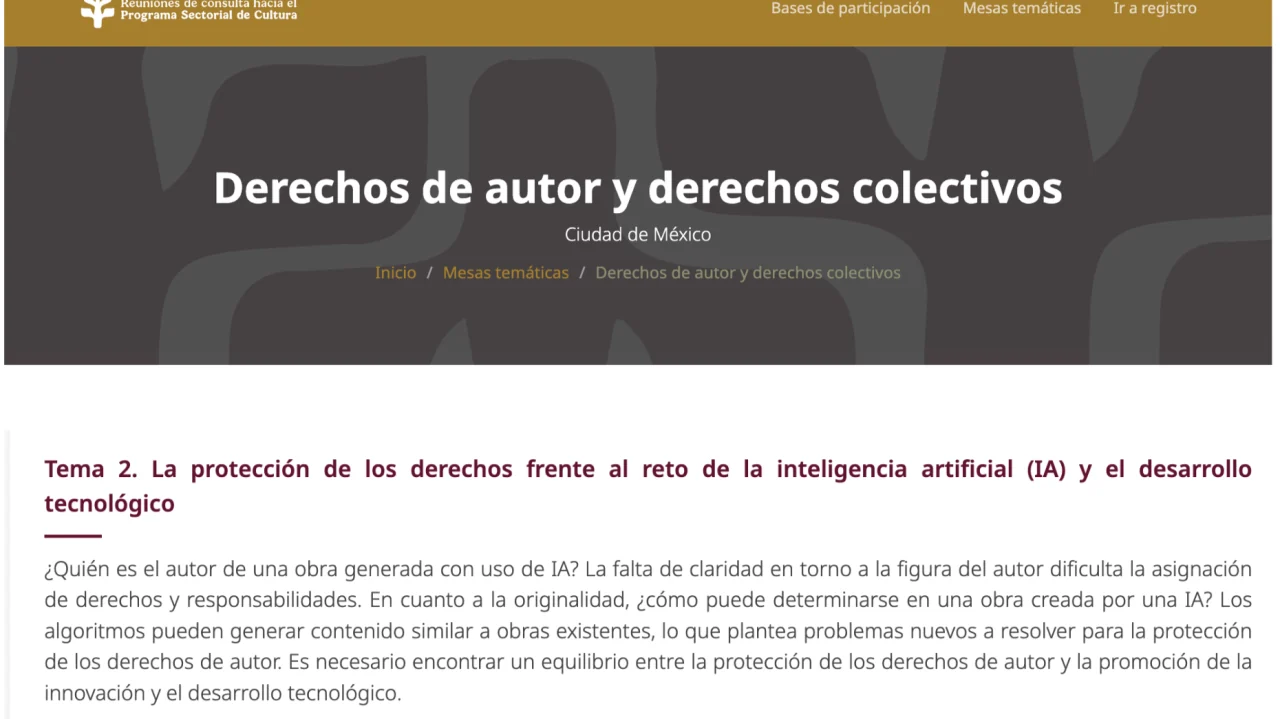
Below I share my written contribution, presented at this high-level colloquium, where I had the honor of sharing the floor with the most distinguished figures in intellectual property in Mexico. This is my position:
"We find ourselves at a historic moment in copyright law.
These rights were born with the purpose of benefiting creators, granting them control over their works and the ability to pass them on to their heirs.
Like all legal fictions, they have continuously evolved to adapt to technological advances.
In 1884, photography sparked an intense debate: could someone claim authorship over something produced by a machine?
The courts eventually recognized those rights, establishing a crucial precedent.
In the 1970s, the photocopier presented a similar challenge by enabling the mass reproduction of works. While courts initially afforded strict protection to authors, necessary exceptions gradually emerged — such as educational use — reflected in the Berne Convention and U.S. fair use doctrine.
On the other hand, the duration of protection also evolved:
It began with 14 renewable years in England (1700). It was extended to 28 years in the United States (1831). In Mexico, it went from the author's life plus 25 years (1947) to the author's life plus 100 years with the 2003 reform.
- It began with 14 renewable years in England (1700).
- It was extended to 28 years in the United States (1831).
- In Mexico, it went from the author's life plus 25 years (1947) to the author's life plus 100 years with the 2003 reform.
This history demonstrates that copyright is adaptable, not immutable.
Today we face two fundamental debates, among many other questions:
Can artificial intelligence (AI) be trained on millions of copyright-protected works? Are works created with AI eligible for protection?
1. Can artificial intelligence (AI) be trained on millions of copyright-protected works? 2. Are works created with AI eligible for protection?
The current answer to the first question is a categorical no, under existing law. However, copyright has proven to be evolutionary and adaptable, shaped by negotiations and social needs.
As to the second debate, although AI can generate content on a massive scale, that content does not arise spontaneously. Its origin lies with those who program, use, and create through it.
It is analogous to civil liability: if an autonomous vehicle causes an accident, liability is determined.
I anticipate that this year we will face the debate over originality — which refers not merely to what is novel or innovative, but to what is genuine by virtue of its origin. AI, given its capabilities, raises serious questions in this regard.
For that reason, I propose:
Keeping an open mind. The law is flexible and reflects social needs. Regulating from a position of technical knowledge. It is a mistake to equate software with human entities or to grant them similar rights. Taking these debates to the courts. As occurred with photography and the photocopier, legal standards are forged through the open clash of ideas. Staying attentive to international cases and precedents. Although we apply national law, copyright is inherently international and requires global harmonization.
- Keeping an open mind. The law is flexible and reflects social needs.
- Regulating from a position of technical knowledge. It is a mistake to equate software with human entities or to grant them similar rights.
- Taking these debates to the courts. As occurred with photography and the photocopier, legal standards are forged through the open clash of ideas.
- Staying attentive to international cases and precedents. Although we apply national law, copyright is inherently international and requires global harmonization.
We are confronting the most consequential technology in centuries, comparable to the Industrial Revolution, or what we today call Industry 4.0. Let us view it with that perspective, and if it is within your power to regulate and legislate, I urge you not to leave Mexico behind.
Copyright will continue to evolve. Our task is to ensure that this evolution takes place with knowledge, openness, and through the appropriate legal channels.
I applaud the existence of this forum, and I hope it is the first of many."
I genuinely hope this is the first of many such forums and I celebrate its existence as an open exercise in dialogue.