IP & Copyright
A False Start: The Regulation of Artificial Intelligence and Intellectual Property in Mexico
The recent Forum on Artificial Intelligence held at the Chamber of Deputies — billed as the 'International Congress on Artificial Intelligence: Potential, Challenges and Opportunities for Mexico' — set out to lay the groundwork for legislation on the subject…
 Aldo Ricardo Rodríguez CortésLegal AI · AI & Law
8 min read
Aldo Ricardo Rodríguez CortésLegal AI · AI & Law
8 min read
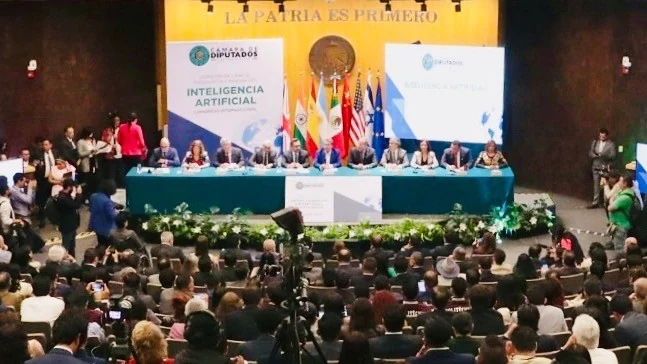
The recent Forum on Artificial Intelligence held at the Chamber of Deputies — billed as the "International Congress on Artificial Intelligence: Potential, Challenges and Opportunities for Mexico" — set out to lay the groundwork for legislation on the subject.
While this effort represents a positive first approach by the Legislative Branch to the topic, several factors indicate that it got off on the wrong foot: key stakeholders were absent, a restrictive vision dominated, and fundamental perspectives were omitted for a balanced debate on intellectual property (IP) and AI.
Notable Absences and Biased Voices at the Forum
The main criticism of the event was the absence of representatives from the private sector companies leading AI development at the global level. Not a single executive or expert from companies such as OpenAI, Google, Microsoft, Meta, or Anthropic participated in the discussion panels, despite their being obligatory points of reference on the subject. Also absent were developers of open-source AI tools and representatives of technology communities that advocate for open approaches. This lack of participation deprived the forum of the perspective of those who drive AI innovation and who typically advocate for flexible regulatory frameworks and the open yet responsible use of data and algorithms.
By contrast, the panel on intellectual property consisted primarily of officials and representatives linked to copyright protection and the entertainment industry. Participants included representatives from the National Copyright Institute (Indautor), the Mexican Institute of Industrial Property (IMPI), and the International Federation of the Phonographic Industry (IFPI), among others. Their contributions, as was predictable, focused on preventing unauthorized use of works by AI systems and on the need to protect creators' rights. The prevailing position advocated for ensuring that any use of protected works by AI systems carry the appropriate authorization and remuneration to their rights holders, while also suggesting the implementation of mechanisms to identify artificially generated content.
This unbalanced composition reflects a troubling tendency: the authorities approach the challenges of AI with the same conceptual tools of the past — when all you have is a hammer, every problem looks like a nail. Artificial intelligence, however, represents a radical transformation that overflows conventional intellectual property frameworks, demanding a rethinking of the fundamental balance among creation, innovation, and access to knowledge.
While these concerns about rights protection are legitimate, the composition of the panel left little room for alternative viewpoints. There was no voice to clearly defend the importance of enabling exceptions or fair use for AI training, nor anyone to highlight the benefits of open collaboration in research and innovation. Even when the moderator raised questions about how to promote open access to and use of AI models without sacrificing IP protection, the answers came from a cast with an evident inclination toward maximalist protection. Only isolated references to the need for balance were heard: for example, an official from the Ministry of Innovation spoke of achieving
"a legal framework for intellectual property […] that balances innovation and the protection of rights."
Nevertheless, those calls for balance were overshadowed by the general tone of the forum, which, out of precaution, privileged restricting the use of content by AI over exploring mechanisms for its regulated exploitation. The result was an incomplete debate: much emphasis on risks and the defense of acquired rights, but little on opportunities and the promotion of open innovation.
The United States Experience: Involving All Stakeholders
The bias observed in Mexico contrasts with the way the United States is addressing the issue of artificial intelligence and intellectual property. As Mexico's main technological and commercial partner, the U.S. experience offers a useful point of comparison. In the United States, regulatory discussions on AI include leading companies and expert voices from diverse backgrounds. In fact, senior executives from top-tier companies (OpenAI, Microsoft, Alphabet/Google, Nvidia) serve on government advisory boards tasked with guiding AI strategy.
For example, in 2024 an AI Safety Board was established within the Department of Homeland Security, composed of private sector specialists, academics, and government officials, whose mission is to design guidelines for the safe use of AI in critical sectors. The inclusion of these companies in advisory roles ensures that policies draw on the practical experience of those who develop the technology, while also holding them accountable for contributing to solutions — for example, on AI safety and ethics.
On the U.S. legislative front, the approach to the subject of IP and artificial intelligence has been more plural and proactive. Members of the U.S. Congress have opened debate on how intellectual property laws should adapt to AI, framing fundamental questions.
Among the concerns under discussion are: Do AI programs infringe copyright by training on protected works? Can AI-generated creations be subject to copyright or patent protection, and if so, who would be the rights holder? Is legislation necessary to protect rights of image and voice against AI-generated imitations?
These questions demonstrate that the United States is seeking a balance between the rights of creators and the free flow of information and technological innovation. To date, the prevailing position in the U.S. has been cautious but inclined not to stifle innovation: the authorities are exploring solutions that reconcile intellectual property protection with AI development, leveraging existing doctrines such as fair use to permit certain algorithm training activities, while also analyzing new safeguards in extreme cases — for example, regulations against malicious deepfakes or non-consensual voice replication. In short, the U.S. approach involves all stakeholders — government, industry, academia, creators — and acknowledges both the risks and the potential of AI, with an eye toward regulation that does not stifle technological competitiveness.
Implications of an Unbalanced Regulatory Approach
The differences between Mexico's and the United States' approach to AI regulation are not trivial. While the U.S. seeks a balance that fosters innovation and protects rights, Mexico's approach appears to lean excessively toward maximalist protection.
A biased or incomplete domestic regulatory approach by Mexico could have serious implications for its competitive position and technological development. Excessively restrictive national legislation on AI and copyright would hinder the country's ability to adapt to the emerging digital economy, placing it at a disadvantage relative to nations that adopt more flexible frameworks suited to technological reality.
If Mexico omits the perspectives of the technology industry and the scientific community in designing its AI policy, it would forfeit the opportunity to strengthen its digital capabilities. A one-dimensional regulatory approach, focused solely on restrictions, would discourage investment in technological development and limit the country's competitiveness in emerging sectors. By contrast, a comprehensive strategy would allow Mexico to leverage digital transformation as an engine of economic growth and social development. Maintaining the current, limited and biased approach would mean relinquishing significant development opportunities in one of the most promising technological fields of the twenty-first century.
A Necessary Balance: Protection and Innovation Through Fair Use
It is important to acknowledge that protecting copyright in the face of AI advances raises real challenges. Mexican creators — from writers and musicians to voice artists and visual artists — express valid concerns about how their works may be used without consent to train AI models that then generate content that imitates or derives from their original work.
Nevertheless, the current reality of artificial intelligence creates a fundamental paradox: in its modern form, this technology would be practically unviable if copyright were interpreted in an absolutist manner. Large AI models require training on massive volumes of data that include millions of works. Obtaining individual licenses for each of those works would be logistically impossible and economically unviable, effectively paralyzing technological development.
The solution to this dilemma may be found in Articles 148 and 149 of the Federal Copyright Law (Ley Federal del Derecho de Autor — LFDA), which establish limitations on economic rights and contemplate the Mexican equivalent of "fair use." These articles could provide the legal basis for allowing certain transformative uses of protected works when they do not affect the normal exploitation of the work or cause unjustified harm to the legitimate interests of the rights holder.
An appropriate legal framework would contemplate the balanced application of these principles to AI training — for example, permitting the use of works to train general-purpose or research models, while establishing the possibility of creating realistic and balanced collective compensation mechanisms for creators when those models are commercialized. This would acknowledge both the transformative nature of AI training and the legitimate interests of rights holders.
International experience shows that the systems that work are precisely those that achieve this balance. Attempting to apply traditional licensing schemes — developed for very different contexts such as the reproduction of music or films — to AI training processes is disproportionate and disconnected from technological reality. The predictable result would be a stagnation in the adoption and development of these technologies in Mexico, placing the country at a competitive disadvantage relative to nations with more adaptive frameworks.
Conclusion: Correcting Course to Avoid Falling Behind
The AI forum at San Lázaro demonstrated both the urgency of discussing the subject and the dangers of doing so without the necessary breadth of vision. Taking this first step is valuable, but doing so without including all stakeholders and all facets of the problem is, metaphorically, a false start. Mexico has before it the opportunity to adjust its stride: to open the dialogue to the missing voices — pioneering companies, advocates for open innovation, independent experts — and to draw on international experience in order to formulate balanced legislation. Protecting the rights of domestic creators is crucial, but it must not mean isolating Mexico from the technological revolution. An intelligent legal framework can both safeguard intellectual property and incentivize the development of AI in an ethical and transparent manner. Otherwise, we run the risk of falling behind while the world — and our USMCA partners — moves forward. In the global race for artificial intelligence, getting off on the wrong foot does not doom the journey, as long as we know how to correct our course in time.